



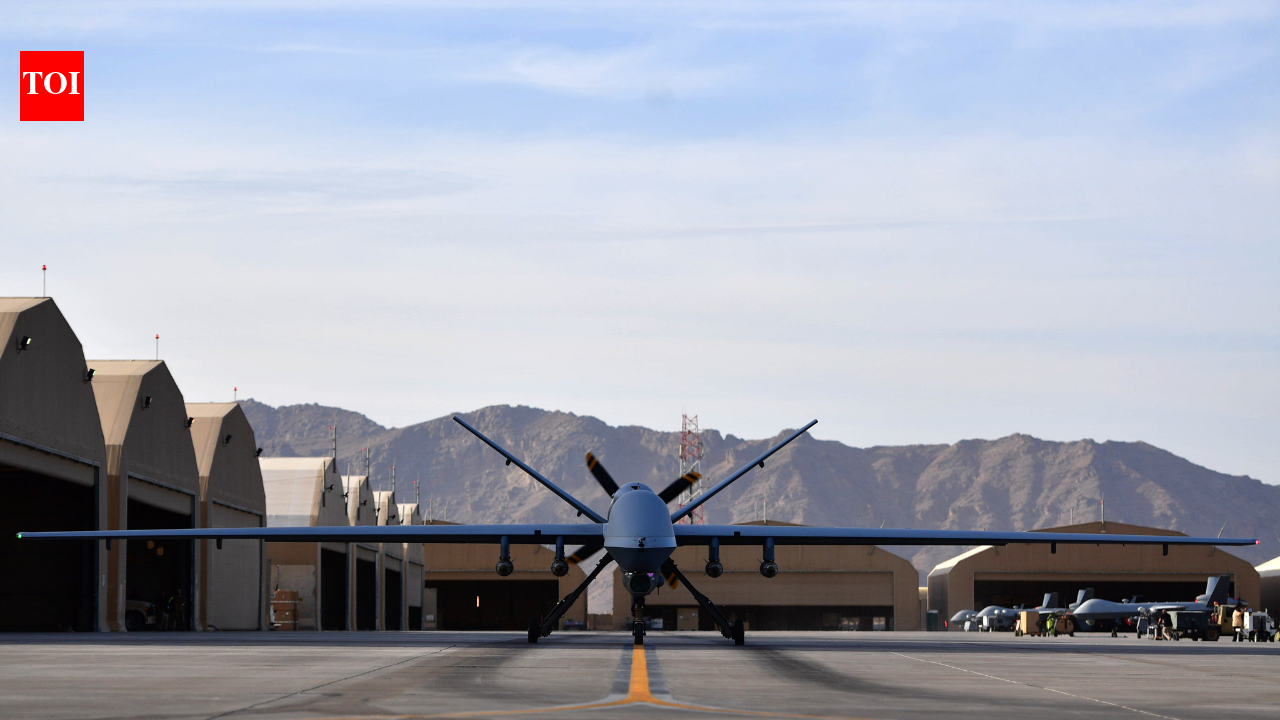
The US military has lost at least 45 MQ-9 Reaper drones during the ongoing conflict with Iran, roughly a quarter of its pre-war fleet. The US had close to 185 Reapers when the conflict began on February 28, split between 165 with the Air Force and 20 with the Marine Corps. The drones have seen heavy use around the Strait of Hormuz, but their slow speed and low-altitude flight profile make them relatively easy targets for Iran’s military and its regional proxies in Yemen and Iraq as well. Not all losses came from enemy fire — some drones crashed after their communications link to operators failed.For nearly two decades, the MQ-9 Reaper has been the quiet workhorse of America’s Central Command theatre, flying surveillance and strike missions across Iraq, Afghanistan, Yemen and Syria, hunting ISIS militants and keeping watch over pirate-infested waters. Slow, high-flying and built as a reconnaissance platform, it thrived in exactly the kind of airspace it was designed for, uncontested skies where nobody on the ground could reach up and touch it.The ongoing conflict in the Gulf region has changed that equation. The war has turned out to be an exception, in which the Reaper’s predictable, plodding flight path, normally an asset for long-endurance missions, has instead made it an easy kill for air defences. It’s that same flight regime that requires the aircraft to fly long, slow and over hostile territory that has made the Reaper a valuable asset. Many of these aircraft are flown remotely from control station by pilots sitting thousands of miles away in the United States, linked via satellites.Loaded with an advanced electro-optic sensor pod for day, night and thermal imaging, various radar options, and up to eight weapons including Hellfire missiles, Paveway laser-guided bombs, JDAMs and Stinger air-to-air missiles, it remains a genuinely potent platform, just not one built for contested skies.India, notably, is buying into this very aircraft across all three services, eight each for the Army and Air Force, 15 for the Navy, in a deal worth over $3 billion, drawn by its 40-hour endurance and the intelligence picture that kind of loiter time makes possible over the Indian Ocean and along India’s land frontiers. These unmanned aircraft are expected to be inducted in 2029. The Navy already operates two leased Reapers, and the defence ministry signed a fresh Rs 1,943 crore deal on Monday to extend that lease by another 30 months. Under the broader acquisition, 21 drones will be assembled in India, ten delivered flyaway, with 34% components sourced locally.
