



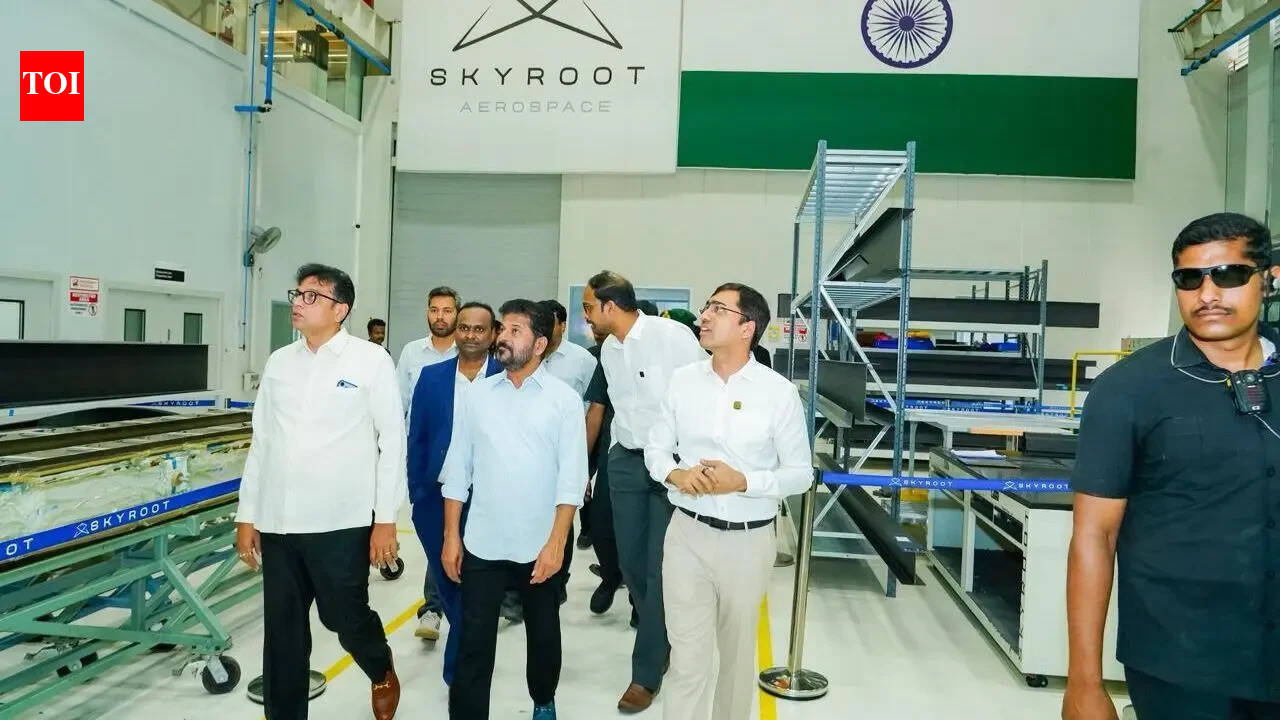
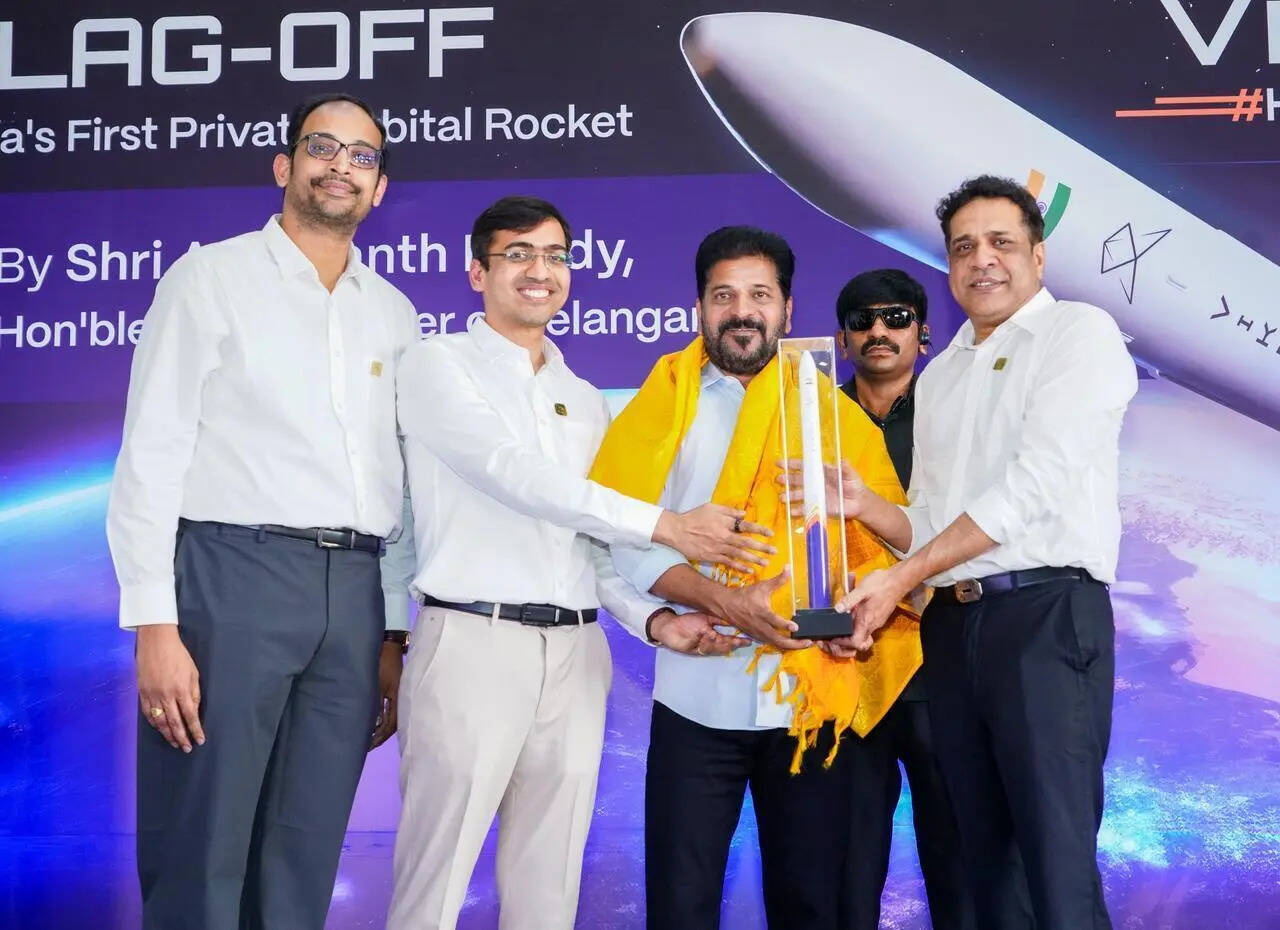
CM Revanth flags off India’s first pvt orbital rocket Vikram-1 at Skyroot Aerospace
HYDERABAD: India’s first privately built orbital rocket moved yet another step closer to its historic mission with Telangana chief minister A Revanth Reddy flagging off Skyroot Aerospace’s Vikram-1 flight hardware to Sriharikota, where the company is hopeful of launching the rocket from the Satish Dhawan Space Centre in June this year.Calling it a proud moment for Telangana and a major milestone in the state’s ambition to emerge as a global aerospace leader, the CM pointed out that Vikram-1 had been entirely designed and developed in Hyderabad which is indicative of the state’s growing importance in India’s aerospace and space technology ecosystem.“Skyroot has developed India’s first privately built orbital rocket to carry satellites into space. The company launched its first rocket (suborbital) in 2022, and reaching the stage of orbital launch in such a short time is a remarkable achievement,” Revanth Reddy said while interacting with the company’s leadership and engineering teams.Telangana industries & IT minister D Sridhar Babu was also present for the flag-off along with other senior officials.
The CM said Telangana was already ranked number one in India in the aerospace sector and pointed to the presence of global majors such as Boeing, Airbus and Safran in the state. He added that the government had set a long-term goal of making Telangana a global aerospace hub by 2047, with aerospace identified as one of the state’s key growth engines.He also linked the rise of the aerospace sector to the state’s export performance. Citing Central government data, he said Telangana recorded the highest growth in engineering goods exports among Indian states, at 117.9% between 2023-24 and 2024-25.He said aircraft parts and defence equipment were among the biggest contributors to this surge, reflecting the rapid expansion of advanced manufacturing capabilities in the state. Revanth Reddy said the government was focusing strongly on building a skilled workforce to support future growth in aerospace and other high-technology sectors.He outlined ongoing efforts through Young India Skills University, Advanced Technology Centres and polytechnic institutions, saying the state planned to bring ATCs and polytechnics under the ambit of the Skills University.According to him, the move is intended to create a uniform, industry-driven curriculum and ensure that training remains aligned with changing industrial requirements. He said the government’s emphasis was not only on student training but also on improving the quality of instructors.“Our focus is on giving the best training to the trainers in these institutions. Tata Technologies is providing training to our trainers in ATCs across the state,” he said.Skyroot Aerospace CEO and co-founder Pawan Kumar Chandana said with this flag-off it will reach Sriharikota over the next week where they will start assembling the rocket for launch hopefully in June this year.Chandana said Skyroot is in discussions with IN-SPACe (Indian National Space Promotion and Authorisation Centre (IN-SPACe) and the Indian Space Research Organisation (ISRO) to get a launch window for the rocket.“We will be announcing the launch window soon,” he said, adding that after the first test launch of Vikram-1 in the next few months the company will have more test launches coming up.“By next year the aim is to get to a capacity where we can produce one rocket a month and probably next year sometime we will be able to reach the full payload capacity of 300kg in each rocket,” he said pointing out that the first few test launches will carry only partial payloads.He describing this as a proud moment not just for India but globally as well because very few companies in the world have the capability and technology to make rockets. “

