




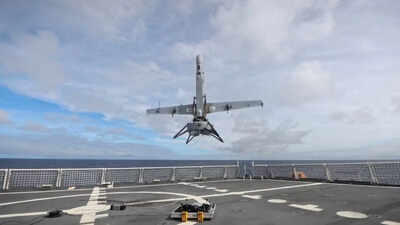
The Indian Navy’s recent Request for Information (RFI) for Tactical Multi-Copter Surveillance Drones marks a significant step to further integrate unmanned systems into maritime security. These drones are designed to provide persistent surveillance of naval bases and coastal installations, around the clock in challenging environments. Equipped with stabilized electro-optical and infrared cameras, automatic target tracking, and anti-jamming technology, these systems will provide the navy real-time intelligence.This RFI was quickly followed by the Defence Acquisition Council’s approval of a Rs 52,000 crore procurement plan, which gave in principle clearance for the procurement of Naval Shipborne Unmanned Aerial System (NSUAS). Which clears the way for the navy to procure runway independent drones that can operate from the small helicopter deck of a warship that may be pitching and rolling in rough seas. The army had earlier this year ordered the V-Bat runway independent drone that can be deployed from any location. This Unmanned Aerial System is built in India by the JSW group. This drone has been tested on ships and could offer the navy an indigenously assembled option.At the same time, the Defence Research and Development Organisation’s (DRDO) Naval Science & Technological Laboratory (NSTL) is developing a high endurance autonomous underwater vehicle. This still underdevelopment unmanned system is expected to provide the navy options in anti-submarine warfare, mine counter measure and surveillance among other type of operations.At the same time the US Navy too is operating and planning to integrate a number of unmanned systems across domains ranging from air, surface and sub-surface environments. The US Navy employed unmanned submarine autonomous systems in demining operations in the Strait of Hormuz, after Iran shut down the critical waterway. The Americans have also been using unmanned aircraft from the decks of their surface combatants as well as from their aircraft carriers. The British Royal Navy recently trialed the Nyan one-way effector drone, a ship-launched kamikaze system. This experiment is part of the UK’s ambition to build a “hybrid fleet” where crewed ships operate alongside swarms of uncrewed platforms. The Defense Investment Plan unveiled in London underscores this shift, highlighting drones as essential to future naval combat.These developments suggest that unmanned systems are poised to transform naval warfare. Unmanned systems will reduce risk to personnel and enable new tactics such as distributed surveillance, surveillance and electronic warfare. The integration of unmanned systems will provide control over critical maritime corridors. Navies worldwide are moving toward a future where unmanned systems are not just force multipliers but central to how conflicts will be fought at sea.

