



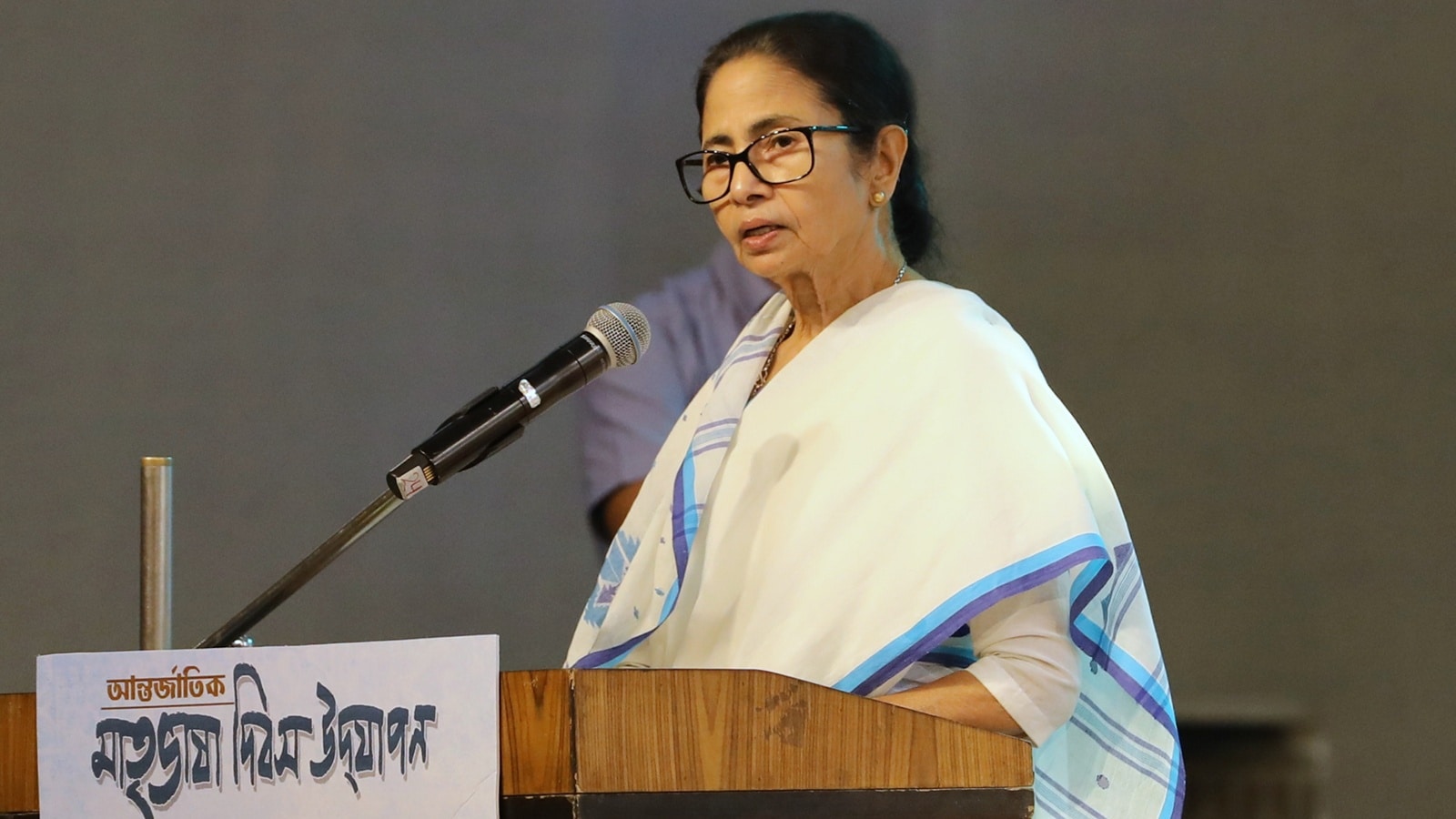
“Khela hobe” — the game will be played — once rang out as a slogan of defiance. In the quiet after an electoral defeat, it begins to sound like something else: A reminder that for women, the game has never been played on equal terms.
This election cycle offered a striking visual contrast. Across four major states, leadership contests were largely defined by men. In Assam, Tamil Nadu, and Kerala, the faces of power remained overwhelmingly male. West Bengal stood apart not only because of its political contest but also because it placed a woman, Mamata Banerjee, at the very centre of it.

That difference matters because when a woman is not just present but central to power, the terms of evaluation shift.
A day after a political loss, the instinct is to reduce a leader to numbers. Seats won, seats lost, margins that shifted. The harder task is to ask what a political life reveals about the system it inhabits. The interest here is not in the individual alone, but in what her trajectory exposes about the conditions under which women are allowed to lead.
Across the world, the relationship between women and power remains uneasy. In Iran, women have risked imprisonment and violence to assert control over their bodies and identities. In democracies elsewhere, women in politics continue to navigate a narrower band of acceptable behaviour, where strength is often recast as excess and ambition as overreach. The question persists: How much space is a woman allowed to occupy before she is seen as too much?
India reflects this tension in its own way. It has produced women who have exercised power in different registers. Sonia Gandhi shaped the direction of a national party through restraint and institutional endurance. Sushma Swaraj commanded admiration across ideological lines through a style that made authority feel accessible and humane. These approaches differ, but they share a common constraint: Navigating a political culture that continues to define the boundaries within which women are expected to lead.
It is within this spectrum that Banerjee’s political life becomes analytically useful. Her trajectory is not simply a story of individual rise; it is a case study in what it takes for a woman to enter and survive a political space that does not easily accommodate her. The methods she adopted, often confrontational and highly visible, reflected a structural reality: Entry into power without inherited networks demands a different kind of political language.
This is where the asymmetry becomes visible. Banerjee has often been described in terms that centre temperament — volatile, shrill, difficult. These labels do more than describe; they frame. Comparable traits in male leaders are more readily interpreted as conviction or strength. The difference shapes how authority itself is perceived.
At the same time, criticism of her politics has not been limited to language. Her party has faced serious allegations around political violence, and governance in West Bengal has been contested. These concerns cannot be dismissed. But it is worth asking whether public critique remains focused on systems and accountability, or whether it often collapses into a personalised reading of a woman’s conduct.
The distinction matters. When structural questions are reduced to personality, the analysis becomes narrower and the standards uneven.
For many women watching, especially young girls encountering politics through images rather than participation, moments like these carry an unspoken lesson. They are not only watching an election result. They are watching how quickly authority can be reframed as failure, how easily confidence can become excess, and how persistence can become defiance.
In that sense, “khela hobe” offers a metaphor beyond politics. It invites a different question: Who gets to play at the centre of the field? For a long time, women have been present at the edges, participating but not defining the game. What leaders like Banerjee signal, regardless of agreement with their politics, is that entry into the centre is possible, but it comes with a cost. That cost is not unique to one leader or one election. It is part of a broader global moment in which women are renegotiating their relationship with power, from the streets of Tehran to the legislatures of Delhi.
It is also a moment to reflect on a recurring pattern closer home: The ease with which women are positioned against other women. Competing claims over who represents women better, who delivers more, who embodies the “right” kind of leadership. These distinctions are inevitable in a democracy. But when one woman’s legitimacy is built on diminishing another’s, something more limiting is at work.
Women in politics will differ in ideology, temperament, and method. They should. But they need not be reduced to opposites in order to be understood.
Elections will come, and elections will go. Parties will win, and parties will lose. That churn is essential to democracy. But something else must endure beyond the arithmetic of results. The recognition that when a woman insists on occupying space fully, she is not merely participating in politics, she is altering its terms.
Her defeat belongs to electoral arithmetic. But the questions her career raises belong to a much wider landscape. The real test is not how women win or lose elections. It is how we choose to read them when they do. “Khela hobe” was never just a slogan. It was a declaration of entry into a space that was not designed to accommodate women on their own terms. Banerjee played the game.
The question that remains is whether more women will now step into the centre of the field, and whether we are prepared to let them play without first asking them to shrink.
The writer is an advocate in the Supreme Court and national spokesperson, Congress

