



7 min readApr 21, 2026 07:05 AM IST
First published on: Apr 21, 2026 at 06:13 AM IST
The justified relief over the defeat of the cynical move to disguise the distortion of India’s electoral map as women’s reservation carries a grave risk. We might forget that the deeper and more serious issues involved in this farcical debate cannot be postponed for long. Suhas Palshikar rightly names what is at stake — federalism, nationalism and the meaning of India (‘In BJP’s bills, federalism & nationalism, not nari shakti, were at stake’, IE, April 20).
Simply put, the Indian union needs a new compact. This may not be a classical Western-style federal compact enshrined in the Constitution. Unlike the “coming together” federations like the US, the Indian “union of states” is an outcome of “holding together” by political units within a nation. Yet, we have an unwritten compact implicit in our Constitution and the ideological consensus during our freedom struggle. This compact needs to be renewed.

Three principles inform this unwritten compact. The first and foremost principle is that of non-domination, which applies both to the relationship of the states of the union with the Centre and with one another. This central principle is tempered by two other overarching principles: Justice among and within the units of the Indian Union and context specificity, which respects local customs, practices and needs.
These three principles must shape the new compact across multiple domains. The aborted debate on delimitation touches only one domain, namely that of the distribution of political power across the states of the Indian Union. It must involve two other dimensions — sharing of economic resources and respecting cultural identity. We need a comprehensive one-time settlement that covers all these dimensions in a package deal. This would require what Shashi Tharoor aptly calls a “great national consultation”, a protracted negotiation involving give and take from all sides. Here is a suggestion about what such a compact could look like. It’s a fair and sustainable bargain, involving give-and-take for everyone.
On political representation, the parliamentary debate was less than honest. The Home Minister kept oscillating between two contradictory claims — that it was necessary to change the share of seats of different states and that the government was committed to retaining the existing ratio. Shorn of this duplicity, the argument in favour of a reallocation of Lok Sabha seats is straightforward and not without merit. The democratic principle of “one person, one vote, one value” enshrined in our Constitution requires that changes in population should be reflected in proportionate changes in the number of seats across and within states. The question is not whether this is a valid principle or not. The real question is whether this is the only valid principle relevant to this case.
The Opponents fell back on the easy but flawed argument that this amounts to punishing the states with lower population growth for the successful implementation of the family-planning programme. The argument is factually weak, as government policy is not the principal determinant of population growth. Besides, characterising faster population growth of any territorial or social group as a national burden goes against the principle of social justice.
A simpler and more honest argument draws upon the principle of non-dominance. The share of the “Hindi heartland” in our Parliament is already overwhelming. Any further increase in its share of seats would ensure its near majority, and could render the non-Hindi states politically irrelevant. This flouts the unwritten social contract of the Indian Union. Therefore, in this instance, the principle of non-dominance must trump the normal democratic principle. This could be operationalised by adopting the Vajpayee formula of 2001 as a permanent arrangement. While the boundaries of Lok Sabha and assembly constituencies would be regularly adjusted to reflect the latest Census, there would be a permanent freeze on the number, or at least the ratio, of seats for each state in the Lok Sabha.
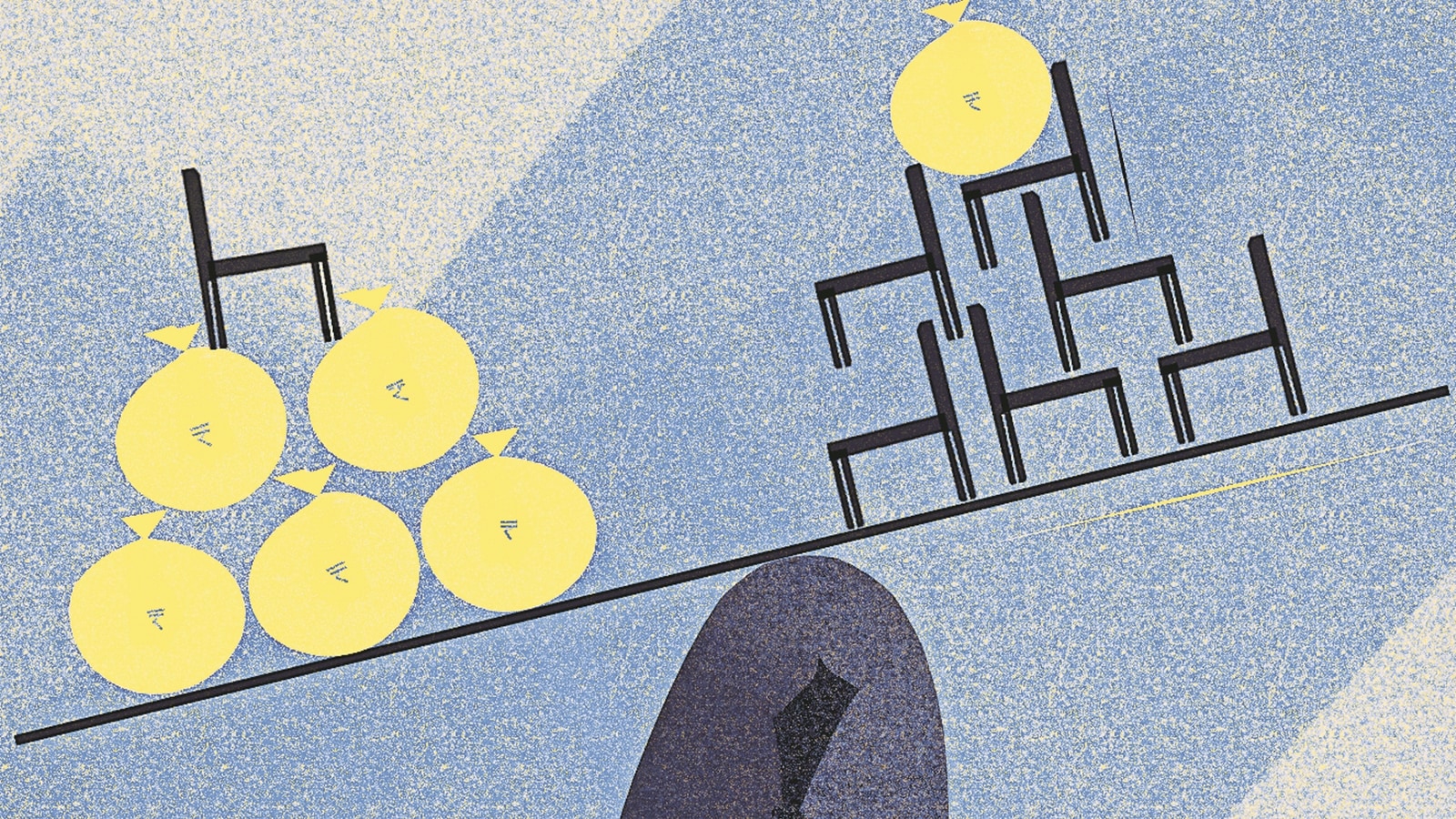
The second part of this bargain is about the sharing of economic resources. In A Sixth of Humanity, Devesh Kapur and Arvind Subramanian have meticulously documented how inter-state economic inequalities have grown, especially since the “liberalisation” of the Indian economy. The per capita income of Gujarat is six times that of Bihar. This gives rise to a tension that we must be alert to. Rathin Roy points out that India is perhaps the only large country “where political power and the majority of the population live in economically deprived areas”.
So far, the political consensus has been to transfer a greater portion of the national resources to poorer states. Of late, this policy has come under stress. There has been a demand for a more “balanced” distribution of central funds in proportion to their share of tax revenue, that is, for more funds to richer states. Such a demand again goes against the principle of non-dominance as well as the principle of justice. It also ignores the truth that the more developed states could become so based on access to cheap labour and an open market from the rest of the country, besides hidden transfers by way of national policies like Minimum Support Price and Freight Equalisation. So, the second part of the new deal could be to enact a law that inscribes the existing practice of recognising population and under-development as principal criteria for the fund transfer formula for any future Finance Commission.
Finally, the new compact could reiterate the broad consensus of our freedom struggle on acknowledging and respecting deep cultural diversities. This would mean a firm assurance on non-imposition of Hindi and equal respect for all the official languages in the Eighth Schedule and state protection for all the non-scheduled languages. Non-imposition of Hindi must not mean imposition of English. Instead, it should be a state recognition of the multilingualism that characterises our civilisation. This needs to be duly incorporated not just in the language policy, but also in educational policy and all the official symbolism of the Indian state, all of which are being bent towards an officious and artificial Hindi.
A new compact along these lines is not an optional exercise. Let us not forget that India is among the very few deeply diverse countries that have survived as a unified political entity. We already have three potential fault lines — geographic, linguistic and now economic — that largely overlap. We simply cannot allow a fourth one, a political fault line, to coincide with and activate the existing cracks. We cannot postpone a new compact for the Indian Union.
The writer is member, Swaraj India, and national convenor, Bharat Jodo Abhiyaan. Views are personal

