



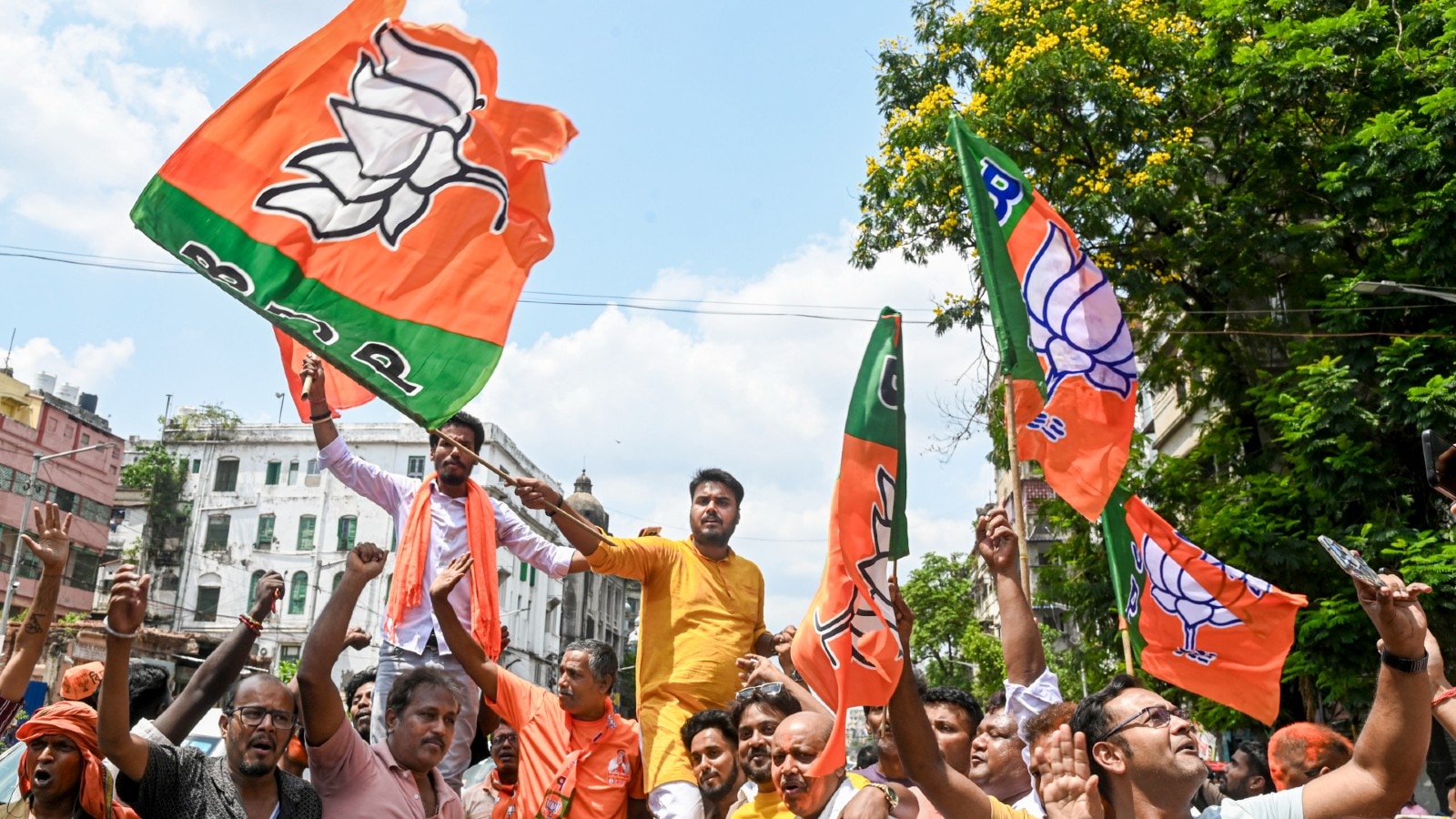
There are election results, and then there are verdicts of history. What the people of West Bengal have delivered in this assembly election belongs to the second category. The trends leave little room for ambiguity: Bengal has not merely changed its government, it has altered the direction of its political destiny.
This is not an ordinary electoral victory for the BJP. It is a landslide and a historic mandate that signals the complete rejection of a political order built on fear, patronage, appeasement, and institutional intimidation. The drubbing delivered to the Trinamool Congress is emphatic. A party that once appeared electorally invincible now finds itself humbled by the democratic will of a people determined to reclaim their future.

For the BJP, for its karyakartas across the country, and for every Indian who believes that peace, development, and dignity are not regional privileges but national rights, this is a moment of profound significance. This is not just a day of celebration, it is a day of vindication.
“Andhera Chatega, Suraj Niklega, Kamal Khilega.” The promise made at the BJP’s founding has found one of its most symbolic fulfilments in Bengal.
West Bengal has always been a civilisational contest. A land that gave India Swami Vivekananda, Rabindranath Tagore, Netaji Subhas Chandra Bose, and Sri Aurobindo had, for decades, remained trapped in a political culture where violence too often overshadowed vision, and power was preserved through division rather than delivery.
The Left institutionalised a long culture of cadre-based coercion. What followed was not renewal, but its mutation, a politics packaged as welfare but sustained through intimidation, selective inclusion, and systematic erosion of democratic confidence. The Marichjhaapi massacre, where Dalits became victims of state-sponsored violence, is an example of Left violence against the socially marginalised.
Syama Prasad Mookerjee, founder of the Bharatiya Jana Sangh and one of Bengal’s most distinguished sons, dedicated his life to the cause of national unity and constitutional integrity. A BJP government in Bengal carries with it the symbolism of ideological homecoming, an overdue tribute. Bengal is the land of renaissance, reform, and resistance. From the Brahmo Samaj to the Swadeshi movement, from Bankim Chandra Chattopadhyay to Tagore, Bengal has shaped India’s intellectual and national consciousness.
What made this victory possible is the BJP karyakarta. No political organisation in India matches the scale, discipline, and year-round commitment of the BJP’s cadre. They reached every village, every ward, every booth. They endured intimidation, persisted through adversity, and remained committed to democratic participation in the face of enormous odds. Much of the organisational credit belongs to Amit Shah, whose political clarity, booth-level precision, and ability to energise the cadre transformed aspiration into execution.
This victory also strengthens the expanding arc of governance and development under the BJP-NDA framework. With Bengal now joining this larger political continuum, the idea of coordinated governance between state and the Centre acquires new strategic depth.
The transformation of Assam and the wider Northeast under Prime Minister Narendra Modi has already demonstrated what political stability, infrastructure expansion, connectivity, and developmental focus can achieve in regions long neglected by Delhi’s political establishment. This momentum is no longer geographically confined.
In Tamil Nadu too, the politics of cynical division, cultural hostility, and selective antagonism towards Hindu identity has begun facing serious democratic resistance. Simultaneously, the BJP’s steady organisational rise in Kerala reflects an unmistakable truth: Politics rooted in development, governance, and national integration is finding resonance even in states once considered electorally impermeable.
At the centre of this expanding mandate remains PM Modi, whose politics has fundamentally reoriented governance toward direct delivery, welfare inclusion, and aspirational citizenship. His appeal cuts across caste, region, and class because it is rooted not in rhetoric, but in visible state capacity.
For Bengal’s women, youth, Scheduled Castes, backward communities, and economically marginalised populations, this mandate reflects a desire to be seen not as fragmented vote banks but as equal stakeholders in India’s growth story. The people of Bengal have endured decades of political violence, broken promises, and stalled aspirations. This election was not merely a transfer of power; it was a democratic correction. Bengal has spoken with remarkable clarity: Enough.
The writer is national spokesperson, BJP
