



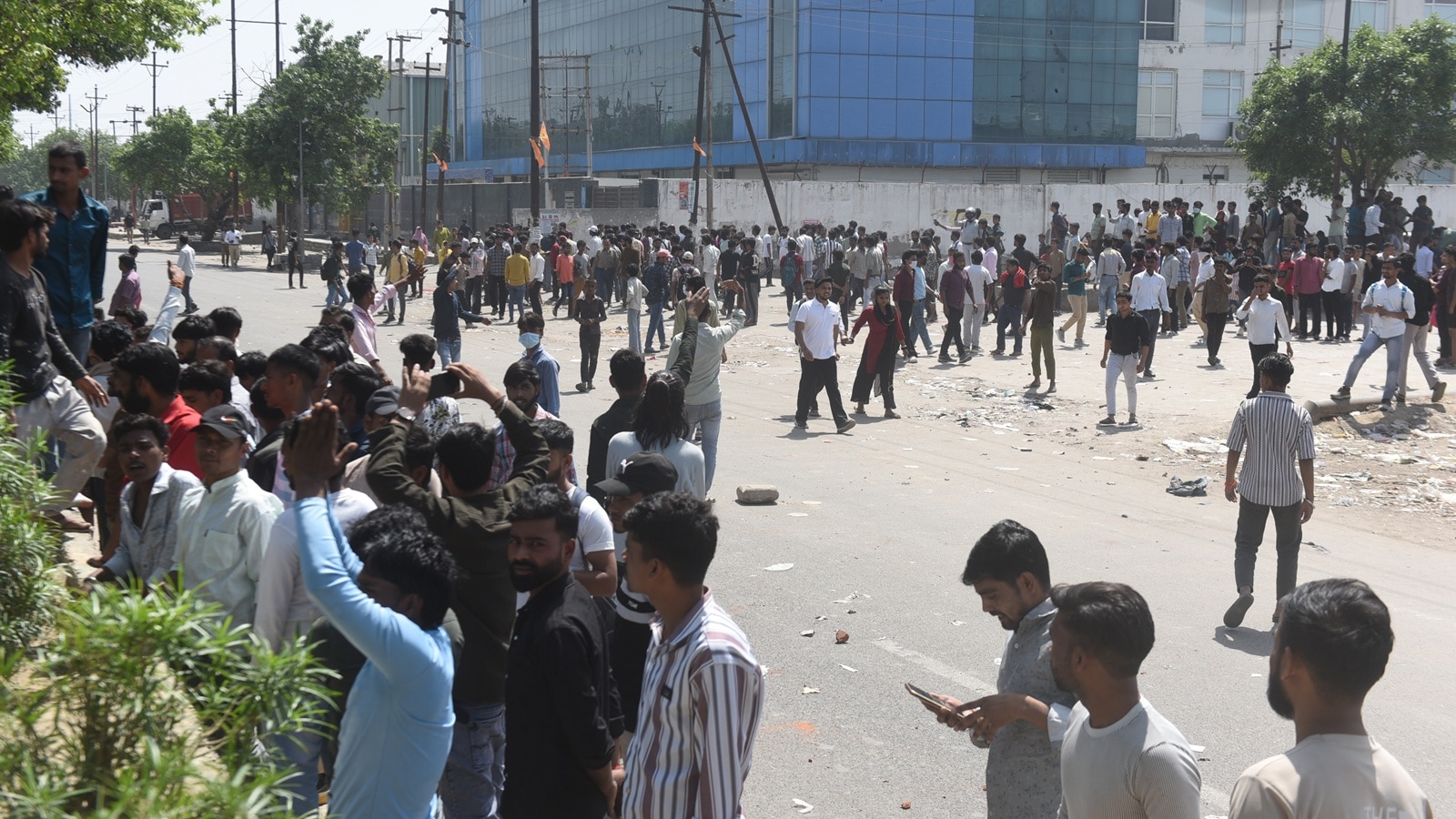
When workers walk out of their factories and shop floors, not to negotiate but to pick up stones and set fire to their workplaces, we must recognise a fundamental breakdown has taken place in the employer-employee relationship, and in the business itself. Such violence is a desperate signal that the worker no longer feels they have a stake in the enterprise’s survival. They see no future in their labour. And they are angry at a place where there is no respect for them as human beings, and their essential contribution through the fruit of their labour.
While the management of these factories must ask why they failed to invest in the human beings behind their machines, the state must look deeper. When this pattern repeats across industrial hubs — from Manesar to Bhiwadi — it is no longer a localised grievance. It is a systemic rejection of a policy framework that has pushed India’s working class beyond the point of precarity.

The ‘Conspiracy’ Diversion
The official discourse often hides behind the convenient bogey of “conspiracy” to explain away protest and unrest. This time is no different. But if we look past the smoke, we find workers earning barely enough to feed themselves, let alone the families they left behind in rural India, to fuel the city and the nation’s growth — a monthly wage of Rs 10,000 in the National Capital Region is not a living wage; it’s not even a minimum wage —it is a starvation wage. It bursts the myth that labour is “unavailable.” Labour is present, but it is being forced into what the Supreme Court has rightly termed “conditions of forced labour” — working for less than the statutory minimum wage.
The Mirage of the Labour Codes
The new Labour Codes officially took effect on April 1, 2026. The central government and the BJP, masters at crafting narratives, argued that they would “modernise” our economy. However, for 90 per cent of India’s workforce, these codes have merely formalised a pro-capitalist, anti-labour paradigm that has existed informally for decades. They prioritise the “ease of doing business” over the “ease of labouring”. It’s hardly surprising that workers’ unions and associations across the political spectrum have spent years trying to fight them, but nobody in Government is listening.
By dismantling existing statutes, the state has given legal cover to unregulated work. The most basic rights secured over a century ago—the 8-hour workday and the right to a minimum wage—are now flagrantly violated at the very doorstep of our capital.
Work and Wages
To understand why the “sixth largest economy with a 6 to 7 per cent growth rate and a four trillion-dollar economy” is shaking at the roots, we must examine three critical constituents of workers’ rights.
The first is the fixation and enforcement of minimum wages. The breach of statutory minimum wage norms is rampant. In Rajasthan, wages have remained stagnant for three years. Nationally, the recommendations of the 2019 Anoop Satpathy Committee—which suggested a floor of ₹375 per day (at 2018 prices) with a monthly housing allowance for urban workers—remain ignored eight years later. Even MGNREGA has been undermined; the transition to the new VBGRAMG scheme will enforce a “blackout period” of two months, with the clear objective of undermining the bargaining power of workers at the only point where they can negotiate for better wages. For the first time in 15 years, the financial year has begun without adjusting the MGNREGA wages for inflation, subjecting rural workers to declining real wages. With MGNREGA undermined, one of the most important safeguards against rural destitution and an urban employment crisis has been repealed.
Second, the sanctity of the eight-hour working day has gone. Workers are routinely coerced into extra hours without overtime pay. While the government may issue post-unrest orders for “double pay,” one must ask: Why does it require a riot to enforce an existing law? And given the completely unorganised nature of the workforce, without unions, these orders are merely paper promises.
The third is the mistrust of unions and unionisation: The Labour Codes have built formidable hurdles against collective bargaining. The state governments’ immediate reaction to the Noida unrest was to round up the few union leaders they could find —a short-sighted move. Unions are the only platform for workers’ voices, and therefore the safety valves of industrial concerns. Without them, protests become spontaneous, unorganised, unpredictable and volatile. When an employer treats the relationship with each worker as purely transactional, they shouldn’t be surprised when the worker’s response is equally cynical—and far more destructive.
From Factories to the Gig Economy
This rot extends into the digital “gig” economy, where workers are atomised through individual micro-contracts. They work for people who refuse to see themselves as employers. Workers are lured into taking up “gig” work for what they think will be a short stint. They end up without an exit, facing the same crushing pressure of work and wages: Shorter delivery times, dwindling pay, and no grievance redress. The labour codes pay lip service to social security protection through impractical and inadequate schemes, while the central government collaborates with aggregators to even try to block state legislation. By refusing to regulate these platforms, the government is incubating the next wave of industrial unrest.
Labour is still COVID-affected.
The pandemic should have been our great warning. We watched millions walk home when we shut the gates of our cities on them. When they returned, driven by the same precarity that forced them away, they hoped for security. Instead, they found escalating costs and stagnant pay.
The skyrocketing price of gas cylinders has been called the “last straw,” but we must examine the full load the camel is carrying. While the affluent switch to induction stoves, the worker is left with a choice between hunger and rage.
If we continue to view the Noida protests as a “law and order” problem rather than a cry for human dignity, we are deluding ourselves. It is time to provide India’s working class with fair wages, decent working conditions and the right to organise.
Given a chance, they will organise, fight for their rights, as well as develop a stake in the business that has given them their sustenance. India’s extreme inequalities have led to a heightened sense of frustration. Noida is only a warning.
Nikhil Dey is a co-founder of the Mazdoor Kisan Shakti Sangathan (MKSS)

