




Neha.Shukla
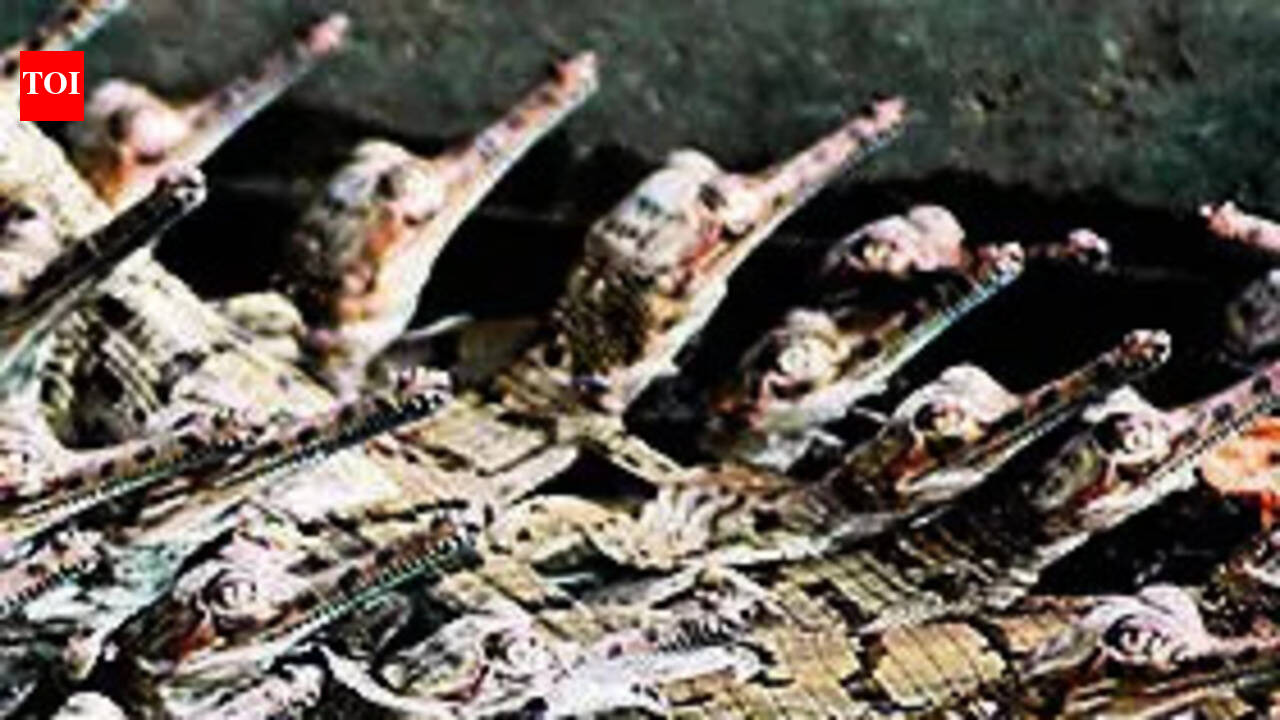
Ghariyal hatchlings
Lucknow: While fewer than 1% of crocodile hatchlings survive in natural conditions, Kukrail Gharial Rehabilitation Centre in Lucknow has given a major boost to the critically endangered freshwater crocodilian with over 95% success rate.The gharial (Gavialis gangeticus), native to the state’s river systems, is listed as critically endangered and is protected under Schedule I of the Indian Wildlife (Protection) Act, 1972. Conservationists note that alongside human-driven pressures, a key factor behind low wild populations is abysmally low survival rate.However the Lucknow facility, founded in 1975, intervenes at the most vulnerable stage of the gharial life cycle. Each year, it collects about 100 to 150 eggs from riverbank nests that are exposed or located in high-risk areas where predation and destruction are more likely. These eggs are then incubated and hatched in controlled conditions, where the centre reports a 95% to 98% success rate.“We mainly collect eggs from nests along the Chambal and Saryu rivers. Collection takes about a week and is done by the staff trained in the exercise,” said Sanjay Kumar Biswal, conservator, Endangered Species Division, Uttar Pradesh. He added that the centre plans to scale up collection to at least 500 eggs for artificial hatching and rearing.After being reared for three to five years, young gharials are released into rivers during winter, when conditions are more favourable. Official figures show that 7,667 gharials have been released since 1976, including at least 1,500 in the last five years.The centre’s captive population has also expanded from five breeding adults in 1976 to 466 gharials at present. Under wildlife exchange programmes, Kukrail has sent gharials to destinations including Japan, Pakistan, the United States and Bhutan.The project has received international attention, with the National Geographic Society describing it as the ‘most successful conservation project in India’ in June 2025.The centre has also become an eco-tourism site, drawing nearly two lakh domestic visitors and more than 100 foreign tourists annually. Tourism and culture minister Jaiveer Singh said the conservation gains have strengthened Uttar Pradesh’s profile as an eco-tourism destination and underlined the need to protect river ecosystems.In the wild, gharials can be seen in and around the National Chambal Sanctuary, Dudhwa National Park, Katarniaghat Wildlife Sanctuary and river stretches across Maharajganj, Bahraich, Barabanki and Hastinapur. Gharials nest on high sandbars, with the Chambal river considered a preferred breeding ground.Conservationists say monsoon currents pose a major threat to hatchlings, as hatching occurs in late May and early June. Rajeev Chauhan of the Society for Conservation of Nature said 1,000 to 1,500 nests are spotted annually in Uttar Pradesh, with roughly 45 to 50 eggs per nest, but only a small fraction survive without intervention.
